Pages

13 April 2012

Cheese Souflée Omlet


I am still cooking for my Dad. He really liked this one. It is, again, a dish for two people, with twice the amounts it will make a meal for four, ideally served with a big mixed spring salad. 


What you need

  • 2 egg yolks whisked with
  • 1 tblsp dry sherry
  • 1 tblsp sweet soy sauce
  • 1 heaped tblsp Italian herbs
  • 1 tblsp mustard or1 tsp mustard powder
  • grated nutmeg, paprika, salt and pepper to taste
  • 2 egg whites whisked with a pinch of salt
  • 1.5 dl cream whipped
  • 1 small tomme ripe soft cheese (Reblochon, Brie, Camambert, Vacherin Mont d’Or, Gorgonzola dolce), cut into slices of about 5 mm thickness.
  • Butter for frying the omelette

What you do

  1. Separate the eggs and whisk the egg yolks vigorously with all the ingredients (sherry, soy sauce, herbs and spices. The mixture should be quite frothy.
  2. Whisk the egg whites with the pinch of salt until it forms peaks.
  3. Whip it until the whisk leaves a trace in the cream.
  4. Fold the cream and the egg whites into the egg yolk mixture, making sure that the mixture remains fluffy and light.
  5. Melt the butter in a non-stick frying pan. Very gently pour the egg/cream mixture into the melted butter and fry over medium heat.
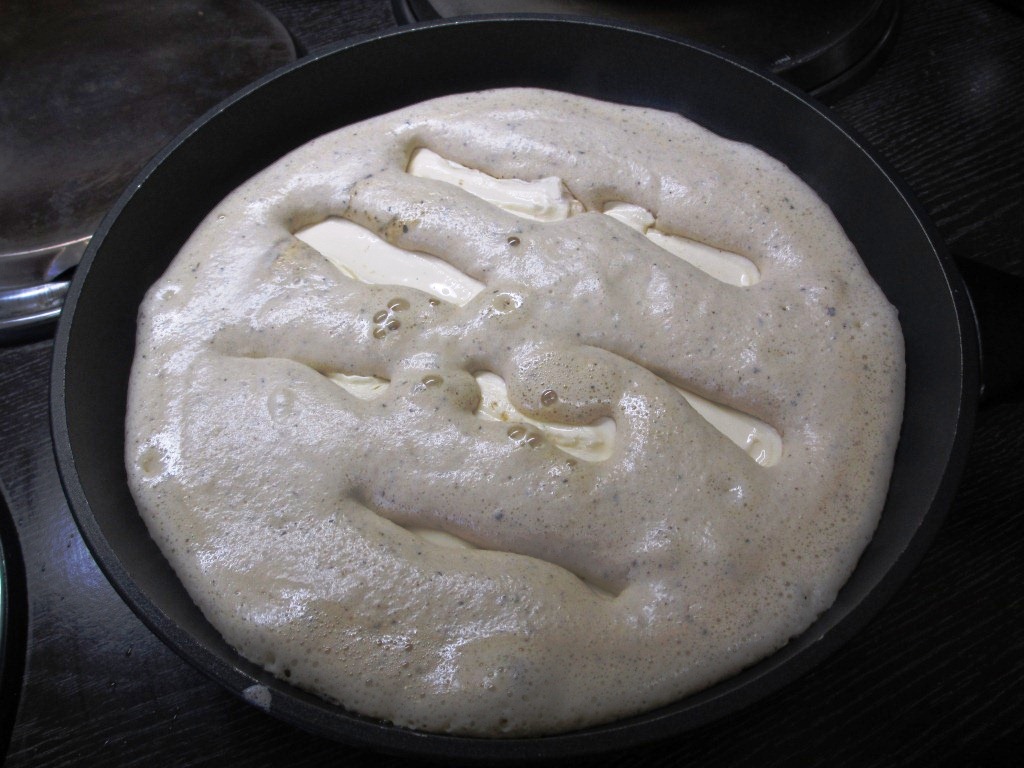
  6. Put in the slices of cheese ensuring that they are evenly spaced.
  7. Reduce the heat a little to prevent burning and fry until the top of the soufflé omlet starts solidifying. Season with more paprika, pepper and nutmeg if you feel it is necessary.
  8. To ensure that the top is done too, put under the grill for 1, maximum 2 minutes (too long and the soufflé effect will be ruined; the taste is still fine but the fluffiness is gone…)
  9. Serve immediately from the frying pan; waiting will deflate the dish.
Remarks

When doing this dish, don’t overdo the salt as the tomme, if it is ripe enough, will actually add plenty of flavour.
How to ripen a tomme? Simple: keep it at cellar temperature for a week, at room temperature for a couple of days. When it feels soft and squashable, it is likely to be perfect.
Cutting it at this stage may be a problem. A cheese knife with holes in it (see picture above) works just fine.  

08 April 2012

Giant Prawns with Stuff in Saffron


It is Easter. Once again, I am back cooking for my Dad. This time the reason is more serious than on past occasions. I feel what I can do now is to remember where my love of food and cooking comes from and to put all best efforts into the meals I do for him.
This is a dish for two people, with twice the amounts it will make a meal for four, ideally served with a big mixed spring salad and boiled rice or perhaps even nicer, with a wild rice mix. For this I sauté 1 small finely chopped onion in a generous dash of olive oil, add the rice, stirring it until it looks glassy before pouring in double the amount of the rice in liquid, to start with, 1 quarter made up of a good white wine, then 3 quarters vegetable broth. I then then allow this to simmer gently until the liquid is soaked up. In the meantime I do the prawns.

What you need (for two people)

  • 4-5 tblsp olive oil
  • 10-12 raw giant prawns
  • 5 cloves of garlic finely sliced
  • 1/2 medium onion, finely chopped
  • 10-15 black olives halved and stoned
  • 1 dried chilli (or to taste)
  • 5 slices of sundried tomatoes with the oil drained off cut into small (1 cm) squares
  • optionally (and not pictured) a handful of roasted pine nuts or almond splinters
  • 1-2 sachets saffron
  • sea salt (and pepper or my Cajun Spice) to taste 

What you do

  1. Heat up the olive oil and add the raw prawns.
  2. Fry them briefly on both sides until they are orange, then take them out and put them aside under a cover to keep them warm.
  3. In the olive oil sauté the onions until golden, add the sliced garlic and stir to make sure nothing goes brown. 
  4. Add the crumble chilli, without the seeds if you like it less hot.
  5. Put in the olives and stir or shake to make sure nothing burns.
  6. Add the almonds or pine kernels if you use any and the sun-dried tomatoes.
  7. Shake the saffron over the mixture add the prawns again and warm them up, do not let it too hot as otherwise the prawns get tough. 
  8. Add sea salt (and pepper or my Cajun Spice) to taste.
Thanks for all the inspiration, I will never forget your love of life, of your family and of good food.

25 March 2012

Fusilli with Mascarpone-Tomato Topping


I got back from work the other day, hungry and tired, so it had to be something quick and filling. This takes only a little longer than it takes for the pasta to be cooked al dente. Apologies about the quality of the one photo (smartphone handled ineptly) and assurances that it is no reflection on the dish...

What you need

  • 400 g of fusilli (great shape for retaining sauce!)
  • 1 medium onion, finely chopped
  • 3 tblsp olive oil
  • 3 cloves garlic either thinly sliced or pressed
  • 1 tblsp Berbere (or slightly less tandoori masala) (see  http://www.congocookbook.com/sauce_recipes/berbere.html or order it from teeparadis.ch)
  • 1 tsp dried chillies (optional)
  • 350 g tomato passata or 4 tblsp tomato purée
  • 2 tblsp Italian herbs
  • 200 ml of mascarpone
  • 1 bell pepper (not strictly in season but I had one kicking around, alternatively a couple of selery sticks), diced about ½ cm
  • salt and pepper
  • grated parmesan cheese or pecorino romano (to top)

What you do

  1. Put the fusilli in boiling, salted water until they are al dente (not too soft!).
  2. In the meantime, sauté the onion in hot olive oil
  3. Add the garlic a little later (preventing it from going brown and bitter).
  4. Dust with berebere, add the chillies (optional) and stir in the tomato (if you use tomato purée, you will need to add a bit of water or red wine).
  5. Stir in the Italian herbs and the mascarpone.
  6. Add the bell pepper or diced vegetables.
  7. Season to taste with salt (or vegetable stock powder) and pepper and simmer till the fusilli are done.
  8. Put the fusilli in an ovenproof dish and distribute the sauce over the top.
  9. Sprinkle generously with (freshly) grated parmesan or pecorino and put under the preheated grill till the cheese gets crispy.
Together with a salad this makes a complete and filling meal.

11 March 2012

Vegetable Quiche with Pâte Brisée (quick fix)


I got the recipe for the base for this from a very good friend, Mary Vallach, who in turn, if memory served got it on French language and cookery course (an excellent idea, I think).  


What you need: Base

  • 125 g wholemeal flour (spelt if preferred)
  • 125 g plain flour (spelt if preferred)
  • 1 generous pinch of salt
  • 1/2 tsp baking powder
  • 100 ml olive oil
  • 100 ml very hot water
  • 1 sealable plastic box
  • (This makes enough for two 24cm quiche dishes; I freeze one either with or without a filling)

What you do: Base

  1. Put the dry ingredients into the sealable box and shake to mix.
  2. Pour in the olive oil and immediately afterwards the hot water.
  3. Seal the box and shake vigorously until the ingredients have formed a solid dough. (Yes, it’s that simple and unmessy!)
  4. Flatten and line a well-oiled quiche dish with the dough (it’s easily spread with your fingers)


What you need: Filling

  • Mustard or mustard powder to cover the base
    1 largish carrot, sliced
  • 1 largish purple carrot, sliced
  • 1 half a beetroot, raw, sliced
  • 1 broccoli, the stem peeled and sliced, the florets made small enough to fit on the quiche
  • ½ cauliflower, also cut into small florets,
  • 1 medium-sized onion, cut into rings and, if preferred sautéed till golden
  • 200 ml crème fraîche
  • 200 ml cream or mascarpone
  • 2-3 cloves of garlic, pressed
  • 1 – 2 eggs
  • 150 gr + flavourful cheese, grated or cut very small (my favourite: Appenzell, alternatively a good blue cheese like Roquefort, perhaps in slightly reduced quantities if it is quite strong)
  • to season: Cajun Spice (see earlier on this blog), salt, pepper, dried herbs
  • (this should be enough for two quiches, possibly one to be frozen)  

What you do: Filling

  1. Presteam the vegetables until they are not yet entirely done.
  2. Sprinkle the base with mustard powder or smear lightly with mustard, then line it with a layer of onion rings.
  3. Distribute the steamed vegetables evenly and flatly across the base.
  4. Mix the cream/mascarpone, the crème fraîche, the garlic, the eggs and the cheese in a bowl and then distribute evenly over the vegetables.
  5. Bake in a preheated oven at 175 to 200°; check after about 20 minutes with a toothpick if the filling is done (the toothpick should be almost dry and not have bits on it when you pull it out).
  6. Together with a salad this is a full meal 
 

05 March 2012

Fasolada/Fasolatha (Greek Bean Stew/Soup)


This, for my taste, is a lovely winter dish, great with celery, carrots and tomato that rich mixture of onions, chilli, garlic and Greek herbs (Rigani), but it tastes lovely at any time of the year. It also has a tendency to fill kitchens and adjacent rooms with a mouth-watering fragrance.
Exact measurements tend to go by the board, mostly, so take what is listed below with the proverbial pinch of salt, preferably sea salt. Once again, this will probably evoke shaking of heads and raising of brows amongst the purists, so take it as my take on this poor people’s dish, not quite totally Greek…

What you need

  • 500 g white beans (not too big and not very small ones either) soaked overnight and rinsed clean
  • plenty of olive oil
  • 2 medium sized onions (or 3), finely chopped
  • 3 cloves of garlic (at least) finely chopped
  • 2-3 dried chillies, depipped if you don’t want it too spicy
  • 4 good sized carrots, thickly sliced
  • 4 to 5 celery sticks, thickly sliced
  • 500 g tomato passata (or 3-4 chopped tomatoes)
  • 2 tbsp rigani (oregano)
  • 1 bunch of flat-leaved parsley, if available, chopped
  • celery leaves separate chopped finely
  • Salt and pepper/dried chillies to taste

What you do

Boil the beans in water (about 2 cm above the bean level) until a thick froth forms.
Pour out the water and rinse the beans thoroughly. (This, I was told by a Greek cook, gets rid of what causes intestinal turmoil…)
Rinse the pan (pressure cooker) and heat a generous portion of olive oil.
Sauté the onions, chillies and garlic until they are glassy.
Add the celery and the carrots and keep stirring.
Then add the beans and the tomato passata, keeping about 150 g to add about 5 minutes before serving. Stir well and season with sea salt. Some water may be added at this point if the mixture seems too dry.
Cook the bean stew either in a pressure cooker (about 20 minutes from when pressure is reached, then letting it cool down by itself to where you can open the pressure cooker) or in a pan (simmer for at least an hour to 90 minutes). The beans should be soft but not mushy.
Stir in the rigani, parsley (if you have them) and the celery and add the last of passata. Simmer for another 10 minutes.
Season to taste and serve in soup bowls with generous lashings of good (!) olive oil.

Some thoughts and, unusually, a poem

For  the original of this recipe I am deeply grateful to my late friend Dimi Hulse from Trypi (Laconia), who not only was a fiercely intelligent woman and great fun to be with, but also a great and “patriotic” cook. She and her help Katarina gave me the most delicious introduction to Greek home cooking and, of course, to this old favourite.
In another life I write and perform poetry. You don’t get points for guessing where this poem came from, one that, despite the sober ending, I could never do without a chorus of rumbling stomach(s)…

Fasolada

The honey acidity of the onions,
the sea-salt tang of the celery,
the sweetnesses of the carrots and the tomatoes,
unfolding in olive oil,

softening with the soaked beans
then melding into the broth,
fill the place with a smell
that is so nearly like mother’s bean soup

that she cooked on damp winter evenings,
perhaps to rekindle summers
on sun-dried Peloponnesian hillsides
or her mother’s kitchen in the shade of Taygetos.

The draining, chopping, slicing, stirring
helps to forget for a time
that you will eat perhaps two mouthfuls
and, limbering up to the second one,

will have to rally your strength
never tiring of commending me
for making fasolada
just like mother’s.